Welcome to the grand splitting of CLI integration tests:

- replaced `test-cli` test suite with `test-e2e`
- made some small fixes along the way
- split integration tests into 3 files
- moved shared logic to `packages/cli/test/helpers/*`
- simplified `_execa` / `execa` / `execute` usage into `execCli` and `exec`
    - simplified arguments required to make these work
- defaulted `execCLI` to set `NO_COLOR=1` to make assertions simpler in tests that aren't testing color/emoji support
- expanded functionality of `formatOutput` to handle error states
- centralized temp dir handling and cleanup
- enhanced `waitForPrompt` to:
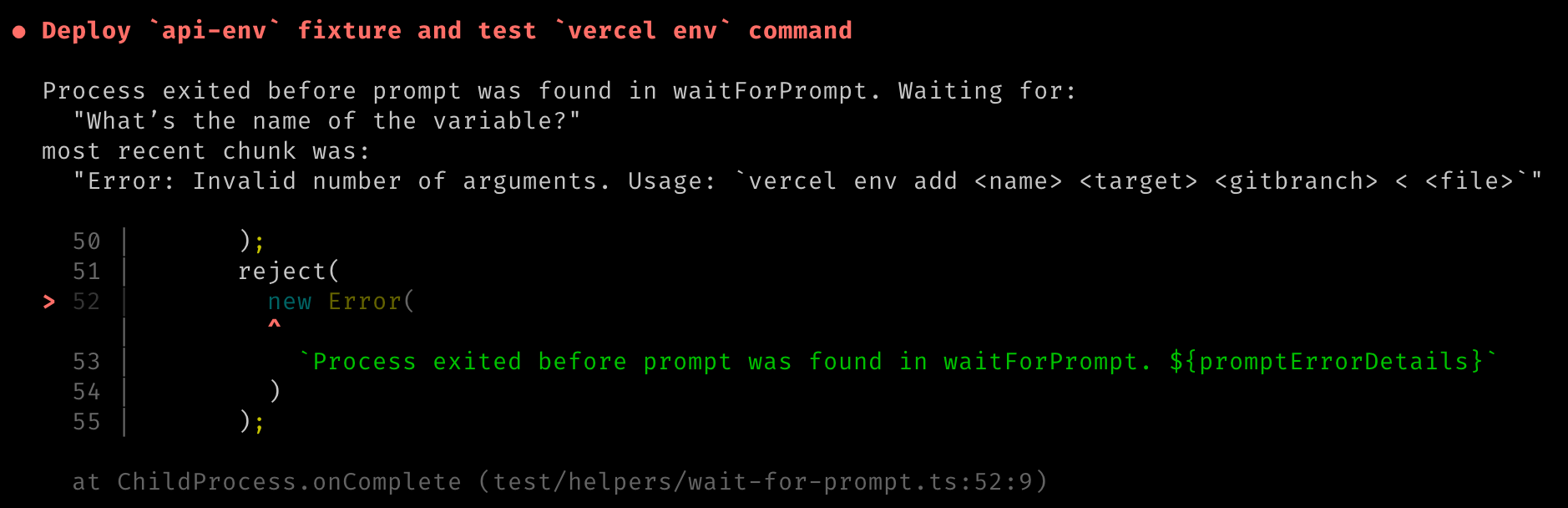
    - more clearly show what it was waiting for
    - support waiting for regex, string, or a function that returns a boolean
    - show what was the most recent thing it saw
    - end early if the process it's monitoring exits
- removed some test pollution where unnecessary, shifted some into `beforeAll`
- renamed unit tests helper from `setupFixture` to `setupUnitFixture` to avoid confusion with the new shared helper `setupE2EFixture`


Some of this could be pulled out into a separate PR, but the feedback cycle is a slog, which this PR is helping to address. I'd be happy to discuss what could be pulled out, but I'd also be happy to get the whole thing through.

---

Wait for prompt failures:

<img width="939" alt="CleanShot 2023-03-27 at 10 24 21@2x" src="https://user-images.githubusercontent.com/41545/227987773-a3582549-32f9-4131-8a35-7be7cc265b66.png">

---

Current Timing:

```
Tests / test-e2e (vercel, 1, ubuntu-latest) (pull_request) Successful in 3m
Tests / test-e2e (vercel, 2, ubuntu-latest) (pull_request) Successful in 8m
Tests / test-e2e (vercel, 3, ubuntu-latest) (pull_request) Successful in 8m
```

---

Before merge, I'll mark the original `CLI` integration test suite as no longer required.
As reported https://github.com/vercel/vercel/discussions/9648, `vc build` does not honor the `--local-config <file>` option.

`vc build` will only load the `vercel.json` (or `now.json`) in the `workPath` which is based on the `rootDirctory`.

If `--local-config` is specified in the command line arguments, then it should take precedence.
Moves the type file out of the cli package and into its own standalone
package. utilizes `@vercel/style-guide` too for typescript config,
eslint, and prettier.
This PR changes the way cron jobs are being created in the build output
API. This is my first time contributing here. If you see something
unusual, let me know.

✅ Good for review

Our goal is to:
- Allow creating cron jobs via the `crons` property of `vercel.json` for
end users
- Allow framework authors to create cron jobs on Vercel via the `crons`
property of the Build Output API configuration

---

As you can see, we removed the previous implementation where cron jobs
could be configured at the function code level (export const cron = ""),
on top of vercel.json `functions` property. Here's why:

- All frameworks would have to implement the configure at the function
code level
- Not all frameworks can easily map a path to a specific function
(example: SvelteKit) and would have to bail on bundling functions inside
the same lambda
- Configuring a path + scheduler provides a better mapping of what cron
jobs are as of today: API routes on a schedule and not functions on a
schedule
- Dynamic routes Cron Jobs will be supported:
/api/crons/sync-slack-team/230
- Query parameters will be supported support:
/api/crons/sync-slack-team/230?secret=32k13l2k13lk21 (= securing cron
jobs v0)
- 100% frameworks compatibility from day one

Next.js and other frameworks may choose to implement their own cron jobs
feature that will then need to be configured through the `crons`
property of `config.json` (build output API).

cc @timneutkens @Rich-Harris

Internal thread:
https://vercel.slack.com/archives/C04DWF5HB6K/p1676366892714349
`spawnSync()` does not throw if the command can't be found in the PATH or if an error occurs. If we use `execFileSync()`, it will throw and that was likely the desired behavior in this test utility function.
We no longer require the memory to be provided in steps of 64mb for
serverless functions.
Instead the memory can now be chosen freely from `128mb` to `3008mb` in
`1mb increments`.

Updates the `vercel.json` schema to reflect that change.
In an effort to speed up CI, we should update the lowest common
denominator to Node.js 16

Note: In April, Node.js 14 will reach EOL so we can update tsconfig
targets and ship a major semver at that time.

---------

Co-authored-by: JJ Kasper <jj@jjsweb.site>
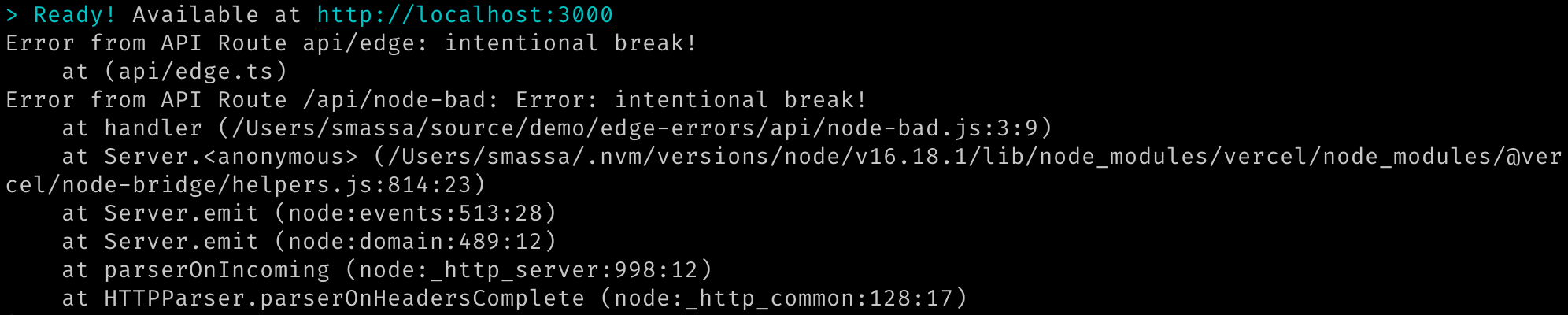
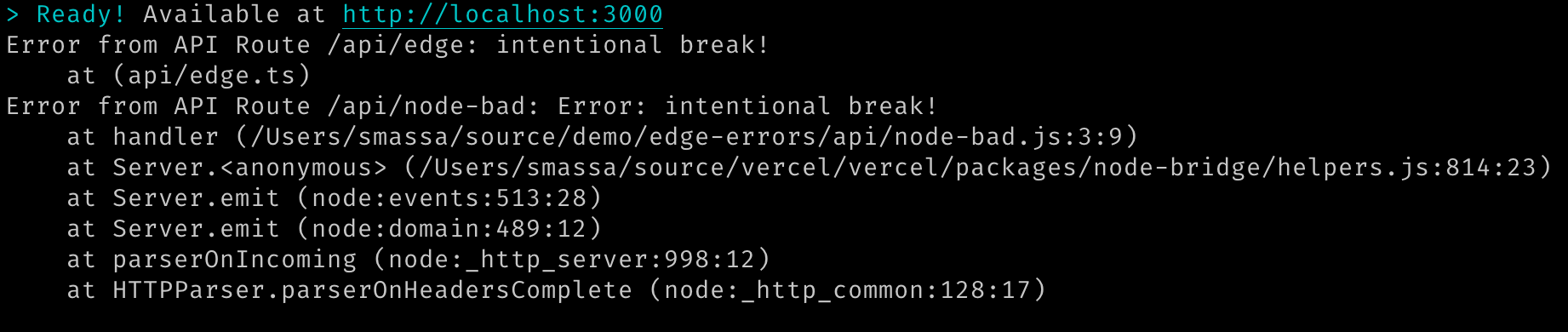
The error messages shown during `vc dev` when an Edge or Serverless functions returns a promise that ends up being rejected could be better.

Main changes:

- removed "socket hang up" error messages because they were not helpful to the user
- changed serverless function error handling to log explicitly and exit
- changed serverless function error message to include the request path
- changed edge function error message to include request path and a faked (but useful) stack trace

## Current

### In Production

**Serverless Function:** In production, for a serverless function rejected promise, you'll see this in the logs:

```
Unhandled Promise Rejection 	{
  "errorType": "Runtime.UnhandledPromiseRejection",
  "errorMessage": "Error: intentional break!",
  "reason": {
    "errorType": "Error",
    "errorMessage": "intentional break!",
    "stack": [
      "Error: intentional break!",
      "    at handler (/var/task/api/node.js:3:9)",
      "    at Server.<anonymous> (/var/task/___vc/__helpers.js:813:19)",
      "    at Server.emit (node:events:527:28)",
      "    at parserOnIncoming (node:_http_server:956:12)",
      "    at HTTPParser.parserOnHeadersComplete (node:_http_common:128:17)"
    ]
  },
  "promise": {},
  "stack": [
    "Runtime.UnhandledPromiseRejection: Error: intentional break!",
    "    at process.<anonymous> (file:///var/runtime/index.mjs:1194:17)",
    "    at process.emit (node:events:539:35)",
    "    at process.emit (/var/task/___vc/__sourcemap_support.js:559:21)",
    "    at emit (node:internal/process/promises:140:20)",
    "    at processPromiseRejections (node:internal/process/promises:274:27)",
    "    at processTicksAndRejections (node:internal/process/task_queues:97:32)"
  ]
}
Unknown application error occurred
Runtime.Unknown
```

**Edge Function:** In production, for an edge function rejected promise, you'll see this in the logs:

```
Error: intentional break!
    at (api/edge.js:10:10)
```

In both cases, in the browser, you see the "This Serverless/Edge Function has crashed." template with no error message or stack trace.


### In `vc dev`


**Serverless Function:** In `vc dev`, for a serverless function rejected promise, you'll see this in the output:

```
Unhandled rejection: Error: intentional break!
    at handler (/Users/smassa/source/demo/edge-errors/api/node.js:3:9)
    at Server.<anonymous> (/Users/smassa/source/vercel/vercel/packages/node-bridge/helpers.js:813:19)
    at Server.emit (node:events:513:28)
    at Server.emit (node:domain:489:12)
    at parserOnIncoming (node:_http_server:998:12)
    at HTTPParser.parserOnHeadersComplete (node:_http_common:128:17)
Error: Failed to complete request to /api/node: Error: socket hang up
```

**Edge Function:** In `vc dev`, for an edge function rejected promise, you'll see this in the output:

```
Unhandled rejection: intentional break!
Error: Failed to complete request to /api/edge: Error: socket hang up
```

## After Changes

### In `vc dev`


**Serverless Function:** In `vc dev`, for a serverless function rejected promise, you'll see this in the output:

```
Rejected Promise returned from /api/node: Error: intentional break!
    at handler (/Users/smassa/source/demo/edge-errors/api/node.js:3:9)
    at Server.<anonymous> (/Users/smassa/source/vercel/vercel/packages/node-bridge/helpers.js:824:19)
    at Server.emit (node:events:513:28)
    at Server.emit (node:domain:489:12)
    at parserOnIncoming (node:_http_server:998:12)
    at HTTPParser.parserOnHeadersComplete (node:_http_common:128:17)
```

**Edge Function:** In `vc dev`, for an edge function rejected promise, you'll see this in the output:

```
Rejected Promise returned from api/edge: intentional break!
    at (api/edge.ts)
```

We can't show the real stack trace for Edge Functions because the bundling + VM execution mangles it. What's rendered here is a fake one, but it's still useful to the user.

If we currently showed the real stack trace for edge functions, it would look like:

```
Rejected Promise returned from api/edge: intentional break!
    at edge (evalmachine.<anonymous>:35:9)
    at FetchEvent.<anonymous> (evalmachine.<anonymous>:87:26)
    at processTicksAndRejections (node:internal/process/task_queues:96:5)
    at async EdgeRuntime.dispatchFetch (evalmachine.<anonymous>:29:7)
    at async Server.handler (/Users/smassa/source/vercel/vercel/node_modules/.pnpm/edge-runtime@2.0.0/node_modules/edge-runtime/src/server/create-handler.ts:46:26)
```

## Follow Up

We'll look into improving the Edge Function error stack traces later.
When Root Directory setting is used, and/or `vc build --output` is used,
do an intelligent "merge" (move) operation rather than copying the
contents of the build output directory to the destination. This should
overall be faster and avoid disk space issues for larger projects.
1. `commandForIgnoringBuildStep` should be run at the project directory level not the monorepo root level
2. Simplifying the `installCommand` because doesn't need the relative root unless it is `npm`
This PR attempts to balance the tests so they run concurrently and therefore faster.

I also sorted the tests so they are deterministic when splitting/chunking.
This PR:

- updates `packages/frameworks` to have most supported frameworks specify which dependency version should reflect the overall framework version
- updates `packages/fs-detectors` to allow framework detection that returns the full `Framework` record instead of just the slug
- updates `packages/next` to return the detected Next.js version in the build result
- updates `packages/cli` to leverage these changes so that `vc build` can add `framework: { version: string; }` to `config.json` output

The result is that Build Output API and supported frameworks will return their framework version in the build result of `vc build` when possible, which is used by the build container  when creating the deployment. The dashboard later retrieves this value to display in richer deployment outputs.

Supports:

- https://github.com/vercel/api/pull/15601
- https://github.com/vercel/front/pull/18319

---

With the related build container updates, we get to see Next.js version in the build output. You'll see this with BOA+Prebuilt or a normal deploy:

<img width="1228" alt="Screen Shot 2022-12-09 at 2 48 12 PM" src="https://user-images.githubusercontent.com/41545/206793639-f9cd3bdf-b822-45dd-9564-95b94994271d.png">

---

### The Path to this PR

I went through all the supported frameworks and figured out how to best determine their versions. For most of them, we can check a known dependency's installed version number.

We can get most of the way only checking npm. For a handful, we'd have to support Go/Ruby/Rust/Whatever dependencies.

I started with a more complex method signature to allow for later expansion without changing the signature. It looked like this, in practice:

```
async getVersion(dependencies: DependencyMap) => depedencies['next']
```

However, after checking all currently supported frameworks, I don't think this will end up being necessary. It also has the constraint that all dependencies have to be gathered and presented to the function even though it only needs to check for one or two. That's not a huge deal if we have them already where we need them, but we don't. We could use a variant here where this function does its own lookups, but this seemed unnecessary and would beg for duplication and small variances that could cause bugs.

Further, if we only look at `package.json`, we're going to either see a specific version of a version range. To be precise, we have to look at the installed version of the package. That means checking one of the various types of lockfiles that can exist or poking into node_modules.

If we poke into node_modules to detect the installed version, we introduce another point where Yarn 3 (default mode) will not be supported. If we read lockfiles, we have to potentially parse `npm`, `pnpm`, and `yarn` lockfiles.

If we use `npm ls <package-name>`, that also fails in Yarn 3 (default mode). We could accept that and go forward anyway, which would look like:

```
const args = `ls ${packageName} --depth=0 --json`.split(' ');
const { stdout } = await execa('npm', args, { cwd });
const regex = new RegExp(String.raw`${packageName}@([\.\d]+)`);
const matches = stdout.match(regex);
if (matches) {
  return matches[1];
}
```

But it turns out there's a `--json` option! That's what I ended up using, for now.

We could explore the lockfile route more, but after some initial digging, it' non-trivial. There are 3 main lockfiles we'd want to check for (npm, pnpm, and yarn) and there are different lockfile versions that put necessary data in different places. I looked for existing tools that parse this, but I didn't find any. We could certainly go down this path, but the effort doesn't seem worth it when `npm ls` gets us really close.

---

### Follow-up Versioning

Now that we know how to determine version per framework, we can vary configuration by version. In a future PR, we could allow a given value to vary by version number:

```
name: (version) => {
  if (semver.gt(version, '9.8.7')) {
    return 'some-framework-2''
  }

  return 'some-framework';
}
```

However, it may still be easier to differentiate significant versions by adding multiple entries in the list.
https://linear.app/vercel/issue/VCCLI-377/rollback-failing-for-enterprise-teams
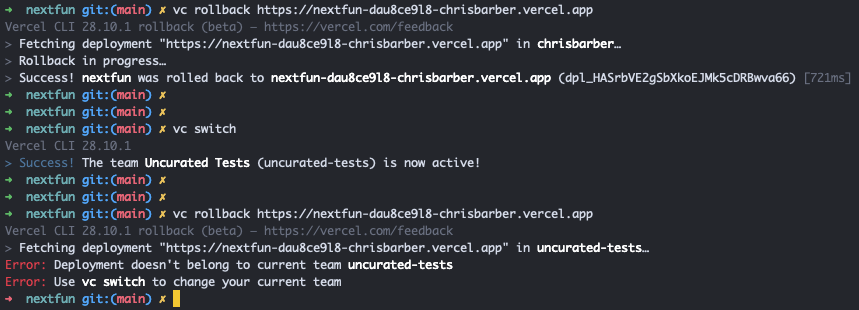
When running `vc rollback` for a deployment belonging to another team, the command will fail requesting the rollback. Technically, the command should have failed trying to get the deployment. This PR checks that the current team matches the deployment being rolled back.
This PR also cleans up a bunch of deployment related things. There were 3 functions to get a deployment and now there's just one which uses the latest v13 API. Get deployment error handling now throws instead of returning an error. The `Deployment` type definition has been updated to match the v13 response and mock deployment data was also updated.
This PR generates lockfiles for the various monorepo build tests and updates the package versions to their latest within the major. This should help make these tests less flaky.
- Depends on https://github.com/vercel/nft/pull/297
- Fixes#7908
- Fixes#6194
This PR bumps `@vercel/nft` (for production) and `ts-node` (for
development) to fix ESM behavior.
Because Node.js cannot dynamically set [loader
hooks](https://nodejs.org/docs/latest-v18.x/api/esm.html#loaders) once a
process is started, I had to change the way `ts-node` is registered by
using environment variables such as `NODE_OPTIONS`. Most of the logic
for TS and ESM was pulled out of the child process and into the parent.
Co-authored-by: Ethan Arrowood <ethan.arrowood@vercel.com>
This adds a `link()` helper function to the `Output` class that is inspired by the `terminal-link` npm package.

The main difference with this version is that it's more tightly integrated with the `Output` class for the purposes of being able to toggle hyperlinks support on/off for [unit tests](4a54b19f46/packages/cli/test/unit/util/output/create-output.test.ts) by setting the `output.supportsHyperlink` boolean.

> **Note:** Since hyperlinks are still a relatively new feature, and users might not yet understand how to interact with them, we should only use this function for progressive enhancement scenarios at this time, and _not_ as part of a critical UX.
Fixes flakey tests / CI:

- git metadata test for corrupted `.git` directory
- version identifier for `build-utils` being using in `fs-detectors`'s `devDependencies`
- bad import from `../dist/..`