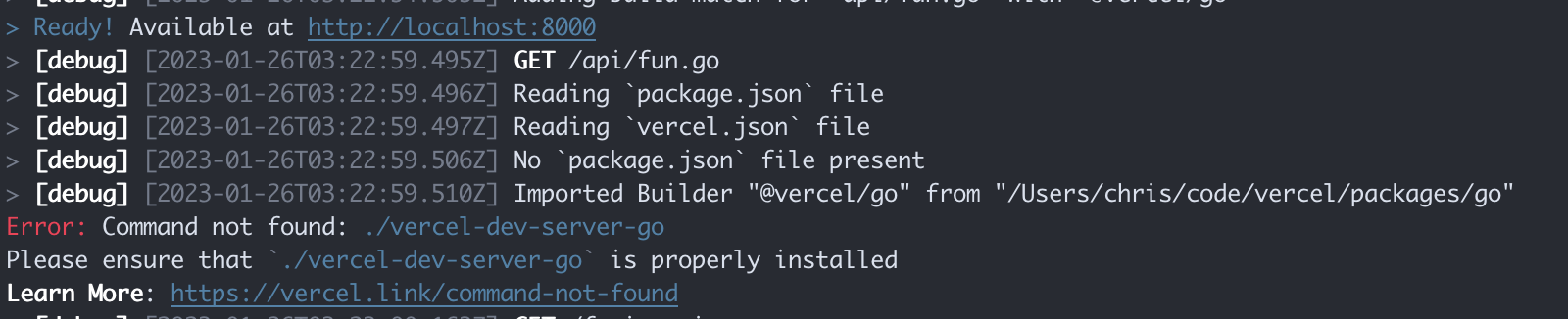
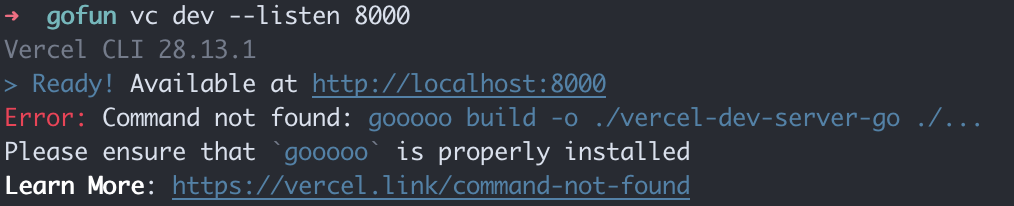
This PR fixes a handful of Go builder issues all related to the selected Golang version being used to build the function:

- `go.mod` version ignored for `vc build` and `vc dev`, uses system `PATH` version only
- `vc dev` fails if `go.mod` does not exist
- If the analyze bin doesn’t exist, downloads golang into `.vercel/cache/golang` instead of a global shared dir
- When running `vc dev`, doesn’t reuse go build code/common settings
- go tidy fails when `go.mod` set to 1.19 or 1.20, but 1.18 or older is installed
- `vc build` builds wrong arch on Apple Silicon/arm64
- `vc build` on Windows doesn't properly resolve "builds" in `vercel.json` due to posix separator issue
- `vc build` on Windows fails with `package <pkg/name> is not in GOROOT` due to posix separator issue
- Removed `actions/setup-go` from all test workflows

I added a test that tests the `go tidy` issue.
Remove `--forceExit` and wait for the child `vc dev` process to close
before continuing.

Listen to the `'close'` event instead of `'exit'` to ensure stdio has
been flushed and closed before continuing.

Some tests cause `vc dev` to spawn child processes that in turn spawn
nested child processes that do not exit when the parent exits, so a
`nukeProcessTree()` helper was added to ensure all spawned processes are
cleaned up. Furthermore, some of the nested child processes don't
respond well to `SIGTERM` and we need to use `SIGKILL` if `SIGTERM`
doesn't do the job.

I uncovered a larger issue exposed by removing the `--forceExit` flag.
The go builder uses `go run` to build and run the go-based serverless
function. Turns out that `go run` will build the executable, then spawn
it with a parent process id (ppid) of `1` (launchd) on macOS. This means
that the go serverless function executable is not detected as a child
process of `vc dev` and won't be cleaned up, yet has inherited `stdout`
and `stderr` keeping Jest alive. The solution is to explicitly `go
build` the serverless executable, then run it.

### 📋 Checklist

<!--
  Please keep your PR as a Draft until the checklist is complete
-->

#### Tests

- [x] The code changed/added as part of this PR has been covered with
tests
- [x] All tests pass locally with `yarn test-unit`

#### Code Review

- [ ] This PR has a concise title and thorough description useful to a
reviewer
- [ ] Issue from task tracker has a link to this PR

Co-authored-by: Sean Massa <EndangeredMassa@gmail.com>
On Windows 10 and 11 machines, environment variables are not case sensitive. The system PATH is actually defined as `process.env.Path`, however Node.js kindly handles the case sensitivity and will automatically return the system path when specifying `process.env.PATH`.

When we clone the environment variables via `{ ...process.env }`, we lose the automatic resolving of `Path` to `PATH`. To fix this, we need to explicitly copy the `PATH`.

#### Tests

- [x] The code changed/added as part of this PR has been covered with tests
- [x] All tests pass locally with `yarn test-unit`

#### Code Review

- [ ] This PR has a concise title and thorough description useful to a reviewer
- [ ] Issue from task tracker has a link to this PR
Review Notes: Turn off diff whitespace.

### Refactor

This PR refactors away the use of the result of `download` for a couple of reasons:
- Keeping `files` and `downloadedFiles` in sync with the file system (like when we rename a file that starts with a bracket) is easy to forget to do, causing bugs
- Nate says that `files` is something we've wanted to move away from using anyway
- It simplifies the code in a few places
- It was getting in the way of other fixes that need to be made

We do still call `download`, but it should be a no-op most of the time.

As a consequence of these changes, this PR also addresses:
- the builder no longer leaves build artifacts around, in many cases
- the builder can compile files that start with brackets again; routes don't seem to allow this to file to respond to a dynamic segments yet, though

### Next Steps

Upcoming PRs will resolve builder issues:

- bracket endpoints responding to dynamic segments
- exported function name conflict handling
- compilation targets should only apply to the source code build, not the analyze go utility

### Operating In-place

We also now have a cleanup step that clears out created files, created directories, and undoes file renames. This fixes an issue where multiple builds on the same directory would fail. It also cleans the user's project code when they are using `vc build`.

Ideally, we'd probably copy all of the code to a separate location, then freely do filesystem operations there. It's not clear to me if this is preferred for large projects because it would have to happen once per endpoint: 100 Go files would cause 10,000 (100 * 100) file copies (or symlinks).

It has to copy once per endpoint because we potentially need all of the files around in case any of them are imported. If we had nft-style tracing for Go, we could copy only what we needed.

This gets more complex in the next step where the exported function names will be renamed during compilation to fix the name conflict issue.
Remove `meta.isDev` checks inside the `build` function because it's never set there. Instead, `startDevServer` would be used.

Also restored the Go tests in a partial form. Will fix the Go builder issues and make sure those features are tested completely in follow-up PRs.
* remove prefix from codeowners

* remove references from ignore files

* Remove prefix from package json and tests

* Add run js without prefixes

* Rename package folders

* Delete auto generated test files

* Remove now-node in integration test

* Put back deleted vercel json files

* Remove eol

* Add styfle suggestion to comment in utils/run.js

Co-authored-by: Steven <steven@ceriously.com>