This adds some tests to the PPR implementation for Next.js. This also
fixes a bug where the static pages were incorrectly generating a header
that falsly indicated that it postponed.
Our tests rely on not being behind deployment protection which is now enabled by default so this adds a step to tests to disable this setting to allow tests to continue working as expected.
- Removes some of the hacks from #10388 that were attempting to resolve an issue with RSC prefetches to `pages` routes in favor of adding rsc rewrites for all dynamic paths, and letting it fall through to a 404 if there's no match
- Fixes an issue where RSC requests were matching the wrong path (filesystem rather than RSC variant) introduced in above mentioned change
  - Closes https://github.com/vercel/next.js/issues/54698
This PR is some cleanup before splitting python e2e tests.

Changes:

- use `probes.json`
- use `/api` autodetection instead of `builds` array

---

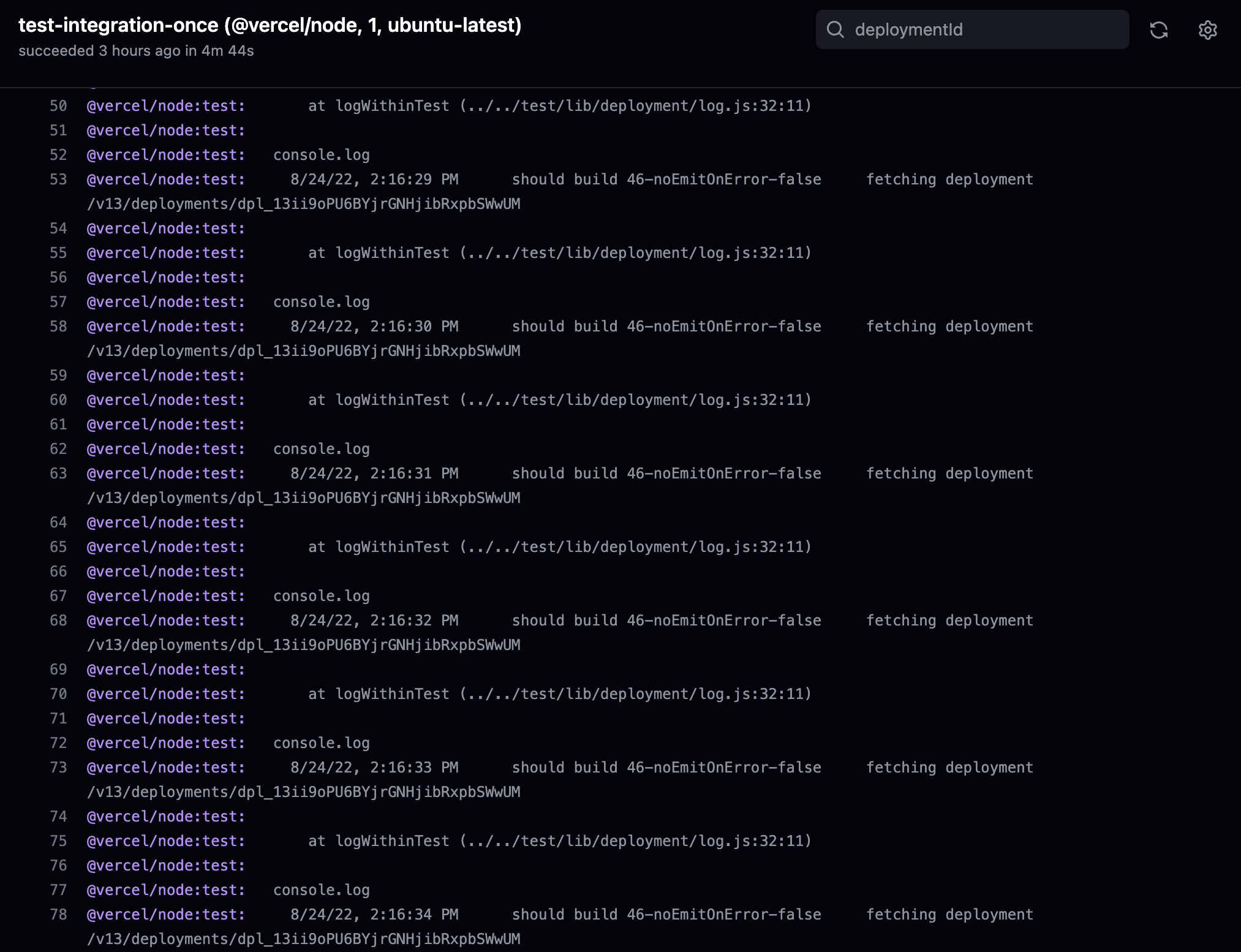
I was also trying to figure out why these tests are so much faster when run locally (293s) vs. CI (1099s). I encountered issues trying to view the build logs for the deployments that are made.
Updates the `responseHeaders` probe checks to properly test for multiple headers with the same name.

Previously the probes were using `headers.get()` which concats multiple headers into a single string, which results in the test not really checking if there are in fact multiple headers with the same name. Using `headers.raw()` allows us to properly test for that.

A couple of Python tests that were already checking for multiple `set-cookie` headers needed to be updated to match the full value, since the check now properly validates the full string match of each header (before it was basically just doing a `string.includes()` check).

This is a precursor for https://github.com/vercel/vercel/pull/9533.
When WEBrick receives `HEAD` requests it discards the body (i.e.
`req.body.nil? => true`), this causes Vercel to throw a
`BODY_NOT_A_STRING_FROM_FUNCTION` since it is expecting the serverless
function to respond with a string in the body.

---------

Co-authored-by: Nathan Rajlich <n@n8.io>
Co-authored-by: Steven <steven@ceriously.com>
Previously, our test fixtures used to use a probes prop in `vercel.json` that was removed right before it was deployed.

This PR allows a separate `probes.json` file with the same content to separate the test fixture input from the test probes.

This allows us to test real "zero config" deployments without a `vercel.json` file.
This PR update the tests suite to wait for Vercel CLI tarball and then use that tarball to run E2E tests.
This is valuable because it will package all the packages in this monorepo to make the tests follow more closely what will happen in production once merged.
Since the current "Find Changes" step takes about 2 minutes, we run that first (it happens concurrently with the tarball preparation). Then once we complete "Find Changes" we wait for the tarball but it will likely be ready by that point since it also takes about 2 minutes. After both of those steps, the E2E tests continue as usual but with the `VERCEL_CLI_VERSION` set to the tarball.
- Related to #7967
- Closes#8245
- Closes#8227
The `probes` in the vercel.json files in tests fixtures weren't allowing both `mustContain` _and_ `responseHeaders` probes due to an `else` block. This PR allows to combine those checks into the same probe test.
Node 12 is EOL and we're starting to reference packages that don't install on node lower than 14, such as nuxt@3 and remix. Let's update to 14 for now.

---

Reimplements: https://github.com/vercel/vercel/pull/7819
[cli] Add `vc build` integration test

Adds a `vc build` integration test to ensure the ncc'd CLI works as
expected to supplement the unit tests from #7869.

Co-authored-by: Steven <steven@ceriously.com>
Node 12 is EOL and we're starting to reference packages that don't install on node lower than 14, such as nuxt@3 and remix. Let's update to 14 for now.
* Migrate ava cli dev tests to jest

* remove outdated test

* update tests

* Update utils

* update stdio to fix stalling

* test stdio tests

* add debug logs

* more logs

* use strip ansi

* update

* add exit flag and fix next dev test

* update timeout for mac ci

* update cancel

* update cancel tests.yml -> test.yml

* update other ids -> names

* remove outdated test

* de-dupe scripts

* remove redwood dev test due to size
The `symlink` symlink wasn't being persisted through Turbo's cache,
so this test was failing. So move the symlink directly into the git repo
since there's no need to create it at build-time (git can store symlinks
just fine).

Additionally, the test itself was not testing that the symlink was indeed
re-created as a symlink from within the lambda environment (it actually
wasn't, due to the upload code not considering symlinks), so the test
has been updated to test for that as well.
.substr() is deprecated so we replace it with .slice() or substring() which aren't deprecated
Signed-off-by: Tobias Speicher <rootcommander@gmail.com>

Co-authored-by: Steven <steven@ceriously.com>
* [python] Upgrade python 3.9

* Fix python path

* Improve testing

* Add support for version selection via Pipfile

* Parse the "Pipfile.lock" instead

* Fix support for Node.js 12
This PR solves an issue where tests would sometimes be rate limited when generating a token. This can be solved by caching the token like we do for E2E tests.

Example failure: https://github.com/vercel/vercel/runs/1098030228#step:11:9376

I also update the `@vercel/node` tests to compare the error message, exactly like how we do it with `@vercel/static-build`.
Some files require execution privileges, such as Prisma, so we must preserve the file mode.

We also want redwood to behave the same as other frameworks and use `yarn build` if available.
This PR improves the error handling when a zero config framework has an unexpected output directory.

Previously, setting a Docusaurus 2.0 build command to `docusaurus build && mv build foo` would fail with the following:

```
Error: ENOENT: no such file or directory, scandir '/vercel/514ce14b/build'
```

With this PR, the error message will show the expected:

```
Error: No Output Directory named "build" found after the Build completed. You can configure the Output Directory in your project settings. Learn more: https://vercel.com/docs/v2/platform/frequently-asked-questions#missing-public-directory
```

I also changed the usage of [`promisify(fs)`](https://nodejs.org/docs/latest-v10.x/api/util.html#util_util_promisify_original) to [`fs.promises`](https://nodejs.org/docs/latest-v10.x/api/fs.html#fs_fs_promises_api) which is available in Node 10 or newer.

Lastly, I updated the test suite to check if the correct error message is returned for builds we expect to fail.
In the latest canary of Next.js pages are no longer nested under the `BUILD_ID` folder and instead are nested under a hash for the page bundle content. To prevent these tests from breaking too often from changes in canary this updates to locate the page bundle using the `buildManifest`. This also updates our latest SSG fixture to test against the latest canary to help ensure the feature doesn't break with a new canary release
This PR adds a test for a deployment as well as `now dev` to ensure both `vercel.json` and `.vercelignore` are applied.

I also fixed the remaining test helpers to work with `vercel.json`.
Added the following env vars, most are undocumented but its good to be consistent:

- `VERCEL_REGION`
- `VERCEL_DEBUG`
- `VERCEL_BUILDER_DEBUG`
- `VERCEL_TOKEN`
- `__VERCEL_SKIP_DEV_CMD`

I also updated the error code prefixes to remove `NOW_`.
There `code` isn't used anywhere, this is just to make it unique and a little shorter.
https://vercel.com/blog/zeit-is-now-vercel

* Updates all org packages from `@now` to `@vercel`
* Updates Now CLI package name from `now` to `vercel`
  * Packages contains `"bin"` entries for _both_ `vercel` and `now` in the package.json
* Updates `now-client` package name to `@vercel/client` (org scoped, for authenticity)

There is also a new `publish-legacy.sh` script which ensures that all the legacy package names (i.e. `now`, `now-client`, `@now/node`, etc.) will still be published as well.

We will remove this legacy publishing logic on Jan 1, 2021.